CURRENT ISSUE
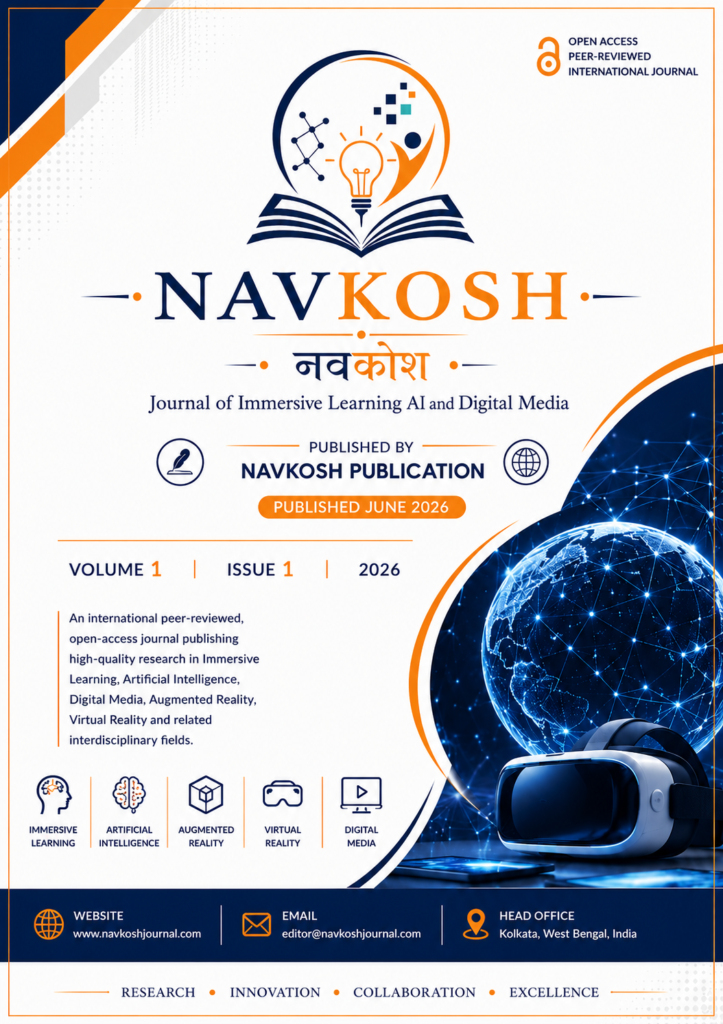
Volume 1, Issue 1 — 2026
Navkosh Journal: Journal of Immersive Learning, AI and Digital Media
Published by: NAVKOSH PUBLICATIONS
Publication Date: June 2026
Open Access | Peer Reviewed | International Journal
About This Issue
Welcome to Volume 1, Issue 1 of Navkosh Journal: Journal of Immersive Learning, AI and Digital Media.
This inaugural issue presents scholarly contributions addressing emerging developments in immersive learning, artificial intelligence, augmented reality, virtual reality, digital media, animation, gamification, educational technology, and related interdisciplinary fields.
The issue brings together research perspectives from researchers, academicians, educators, practitioners, and emerging scholars exploring the role of technology in transforming learning, creativity, communication, and digital experiences.
We sincerely thank all authors, reviewers, editorial members, and contributors whose efforts have supported the launch of Navkosh Journal.
Dr. Deepak Sharma
Editor-in-Chief
Navkosh Journal
1. Development of Contemporary Bohemian Costumes Using Traditional Mandana Art Motifs through Discharge Printing
Dr. Ranu Burad*
Associate Professor, Poornima University, Jaipur, India
Corresponding Author: ranu.burad1@poornima.edu.in
Article Type: Original Research Article
Abstract
This study is designed to understand the process of creation of modern Bohemian costumes based on traditional Mandana art motifs by adopting the discharge printing technique. Mandana is a folk-art practice of Rajasthan and Madhya Pradesh, in which motifs of geometry and symbolism are traditionally drawn on walls and floors. The motifs were translated to the surface of textiles by selective removal of colour (discharge printing) from dyed fabric. The research employed a design-development approach. Silhouettes were gathered from other sources and assessed by 20 design experts, followed by the development of design sheets containing 16 different arrangements of the motifs. Selected designs were subsequently transformed into garments and evaluated by 50 female consumers aged 18–25 years using a five-point scale. The garments were assessed based on colour, motif, fabric, silhouette, motif placement, innovation, concept, price, and appearance. The results indicate that respondents welcomed the integration of Mandana elements with Bohemian silhouettes, with the combination of Design 1 and Layout 1 receiving the highest preference. The study demonstrates that traditional folk-art elements can be effectively incorporated into contemporary fashion while retaining their cultural identity. It further highlights the potential of discharge printing as an appropriate technique for developing unique and culturally relevant textile patterns and contributing to the preservation of Mandana art through contemporary clothing.
Keywords: Mandana Art; Bohemian Fashion; Discharge Printing; Textile Design; Folk Art; Traditional Motifs; Contemporary Fashion; Rajasthani Art
Pages: 1–11
2. Designing Inclusive Digital Education Using Game Design Principles and Interactive Multimedia
Dr. Niket Mehta*
Assistant Professor, Department of Animation and Multimedia, Birla Institute of Technology, Mesra, Noida Campus, Noida, Uttar Pradesh, India
Corresponding Author: niket@bitmesra.ac.in
ORCID ID: 0000-0001-7832-2104
Article Type: Original Research Article
Abstract
Digital education has emerged as a transformative force in democratizing access to knowledge. However, ensuring inclusivity, engagement, and meaningful participation remains a significant challenge, particularly for learners from diverse socio-economic and technological backgrounds. This study explores the integration of game design principles and interactive multimedia into digital learning environments to enhance accessibility, motivation, engagement, and learning outcomes. Drawing upon gamification, user-centred design, and multimedia learning theories, the study proposes a structured framework for designing inclusive digital education systems that prioritise learner engagement, adaptability, and cognitive effectiveness. Core game-design elements, including progression systems, feedback mechanisms, rewards, narrative structures, and interactive challenges, are examined in relation to educational objectives. The study further considers the role of animation, audio-visual storytelling, simulations, and interactive technologies in addressing barriers associated with digital learning. Practical examples from Indian digital education initiatives and multimedia-based pedagogy are discussed to demonstrate how interactive learning environments can support diverse learners and promote equitable access to education. Based on the integration of pedagogical theory and design practices, the study presents the EMPOWER model as a structured approach for educators, instructional designers, and policymakers seeking to develop inclusive, scalable, and engaging digital learning ecosystems. The study highlights the potential of game-based and interactive multimedia approaches to make digital education more accessible, participatory, and learner-centred.
Keywords: Digital Education; Gamification; Interactive Multimedia; Inclusive Learning; Game-Based Learning; E-Learning Design; Digital Divide; India EdTech
Pages: 12-25
3. A Study on the Contribution of Indian Animation to Enhancing Cognitive and Creative Skills among Animation Students
Deepak Ramesh Giri*
Assistant Professor, Animation, Vishwakarma University, Pune, Maharashtra, India
Corresponding Author: deepak.giri@vupune.ac.in
ORCID ID: 0000-0001-5301-0171
Article Type: Original Research Article
Abstract
With the rapid growth of the animation industry, animation has evolved beyond entertainment to become an effective medium for education, visual communication, and cognitive development. Indian animation, with its distinctive cultural narratives, visual storytelling traditions, and contemporary digital practices, offers significant opportunities for developing cognitive and creative abilities among animation students. This study examines the contribution of Indian animation to the development of cognitive skills, including memory, attention, problem-solving, visual perception, spatial reasoning, and critical thinking, along with creative abilities such as imagination, innovation, visualization, and creative thinking. A mixed-method research approach was adopted, involving surveys, interviews, observations, and practical assignments conducted with animation students, educators, and industry professionals. The findings indicate that engagement with Indian animated content and exposure to its production processes can contribute positively to students’ cognitive and creative development. The study further highlights the educational potential of culturally relevant animation content in strengthening visual learning and encouraging students to explore creative approaches to storytelling and animation production. The research suggests that the systematic integration of Indian animation and culturally specific visual narratives into animation curricula can support holistic skill development and provide students with a stronger connection between cultural knowledge, creative practice, and contemporary digital animation.
Keywords: Indian Animation; Cognitive Skills; Creative Skills; Animation Education; Visual Learning; Creativity; Cognitive Development; Higher Education
Pages: 26-37
4. The Role of Character Design in Enhancing Visual Storytelling: A Comparative Literature Review of Human-Created, AI-Generated, and Hybrid Character Design
Moumita Mukherjee
Department of Applied Arts, Amity University Kolkata, Kolkata, West Bengal, India
Article Type: Review Article
Abstract
Character design is a fundamental element of visual storytelling and visual communication, as characters often serve as the primary vehicles through which narratives, emotions, and ideas are conveyed. The emergence of generative artificial intelligence has introduced new approaches to character creation, raising questions regarding creativity, emotional expression, narrative coherence, and audience engagement in AI-assisted visual production. This paper presents a comparative literature review examining three approaches to character design: human-created, AI-generated, and hybrid human–AI workflows. The study synthesises existing research from animation, character design, visual communication, artificial intelligence, and human–AI interaction to identify similarities, differences, and emerging trends across these approaches. A narrative literature review methodology was adopted, involving structured keyword searches across six academic databases, followed by screening and thematic analysis of selected literature. Ten core academic and preprint studies were examined in depth. The reviewed literature indicates that character design functions as an important communicative device across animation, children’s media, entertainment, and branding. Existing studies also suggest that audiences tend to favour human-created visual work, while unguided AI-generated outputs may face challenges related to narrative consistency, emotional depth, and contextual coherence. Hybrid workflows, in which AI-assisted generation is combined with human creative direction and refinement, demonstrate greater potential for maintaining creative and narrative control. The review identifies a significant research gap, as existing literature does not provide a direct controlled comparison of human-created, AI-generated, and hybrid character designs within a single empirical study. This gap provides a foundation for future research examining audience perception, storytelling effectiveness, creativity, and emotional engagement across different character-design approaches.
Keywords: Character Design; Visual Storytelling; Audience Engagement; Animation; Illustration; Artificial Intelligence; Visual Communication; Human–AI Collaboration
Pages: 38-47
Digital Illustration and Visual Storytelling in the 21st Century: A Review of Emerging Trends
Tannistha Pyne
Student, Master of Fine Arts, Amity University Kolkata, Kolkata, West Bengal, India
Email: tannistha156@gmail.com
ORCID ID: 0009-0008-8572-6375
Article Type: Review Article
Abstract
For centuries, artists have relied on traditional materials such as paper, canvas, paints, and pencils to create visual art and communicate stories. In the 21st century, digital illustration has emerged as a significant medium of visual storytelling, transforming the ways artists create, distribute, and interact with visual content. The development of computers, tablets, digital drawing tools, and creative software has made illustration more accessible, efficient, adaptable, and widely shareable. This review examines emerging trends in digital illustration and their influence on contemporary visual storytelling, with particular attention to interactive media, social media platforms, and artificial intelligence. The study reviews selected books, journal articles, and scholarly publications published between 2010 and 2026, along with significant foundational works on visual communication and digital media. The reviewed literature indicates that digital illustration has expanded visual storytelling beyond static imagery towards more dynamic, interactive, and digitally distributed forms. Social media has further enabled illustrators to reach global audiences, build communities, and receive direct audience engagement. At the same time, advances in artificial intelligence and automated image-generation technologies have introduced new creative possibilities while raising concerns regarding originality, authorship, artistic identity, and the distinction between human-created and machine-generated visual work. The review concludes that digital illustration continues to reshape contemporary visual storytelling by combining traditional artistic principles with emerging technologies, while also requiring artists and educators to critically address the creative and ethical challenges associated with rapidly developing digital tools.
Keywords: Digital Illustration; Visual Storytelling; Emerging Trends; Digital Art Tools; Social Media; Artificial Intelligence; Visual Communication
Pages: 48-56