 CURRENT ISSUE
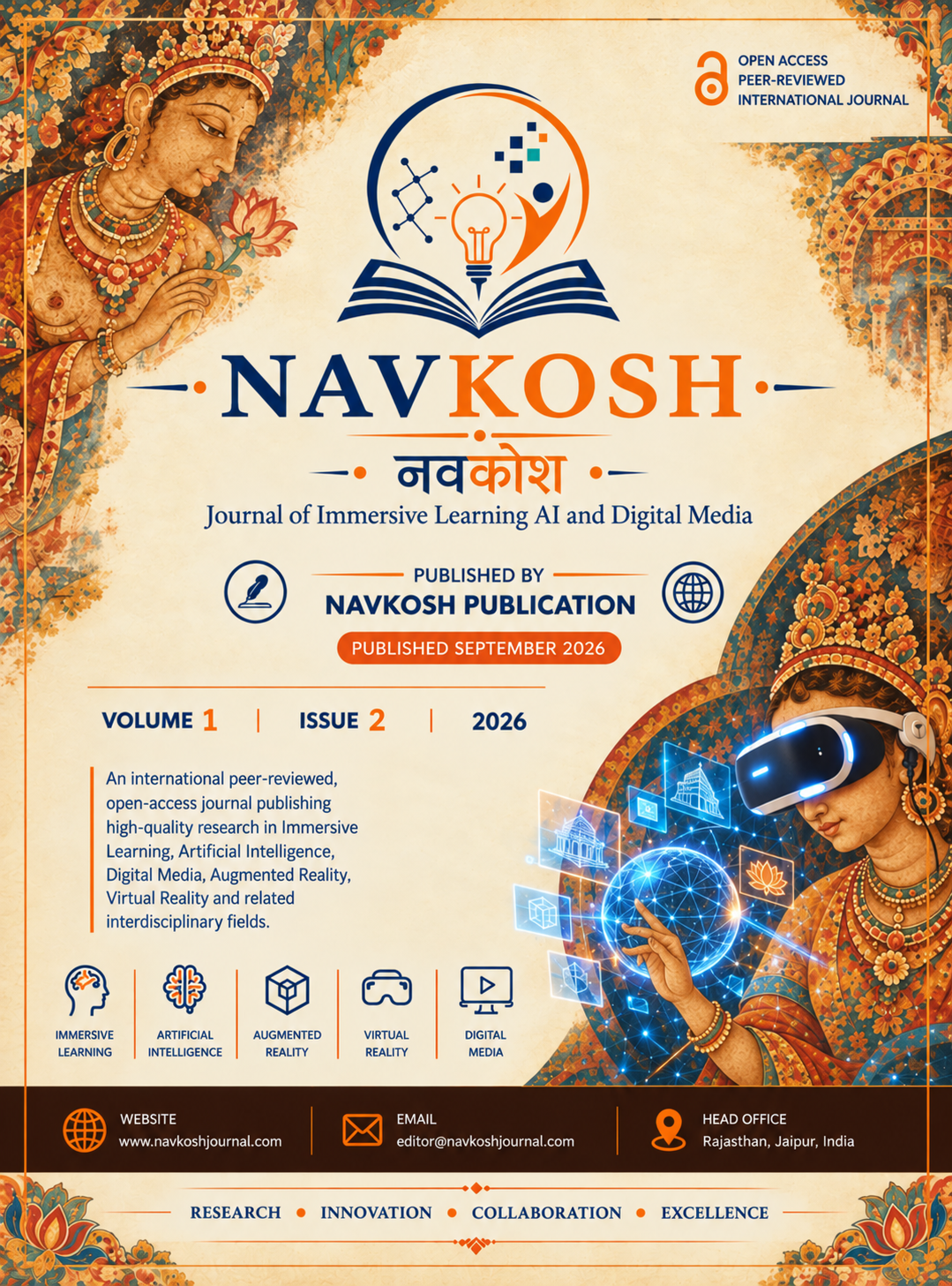
Volume 1, Issue 2 — 2026
Navkosh Journal: Journal of Immersive Learning, AI and Digital Media
Published by: NAVKOSH PUBLICATIONS
Publication Date: September 2026
Open Access | Peer Reviewed | International Journal
About This Issue
Welcome to Volume 1, Issue 2 of Navkosh Journal: Journal of Immersive Learning, AI and Digital Media.
This 2nd issue presents scholarly contributions addressing emerging developments in immersive learning, artificial intelligence, augmented reality, virtual reality, digital media, animation, gamification, educational technology, and related interdisciplinary fields.
The issue brings together research perspectives from researchers, academicians, educators, practitioners, and emerging scholars exploring the role of technology in transforming learning, creativity, communication, and digital experiences.
We sincerely thank all authors, reviewers, editorial members, and contributors whose efforts have supported the launch of Navkosh Journal.
Dr. Deepak Sharma
Editor-in-Chief
Navkosh Journal
1. Integrating Augmented Reality (AR), Virtual Reality (VR), and Animation in Design Education: Opportunities, Challenges, and Future Directions
Arko Dey
J.C. Bose University of Science and Technology, YMCA, India
Article Type: Conceptual Research Article
Abstract
This study examines the opportunities, challenges, and future directions associated with integrating Augmented Reality (AR), Virtual Reality (VR), and animation into design education. These emerging digital technologies are transforming teaching and learning practices by promoting immersive experiences, interactive visualization, creativity, collaboration, and practical skill development. The article adopts a conceptual approach to explore the educational potential of AR, VR, and animation and their relevance to contemporary design curricula. It discusses how these technologies enable students to engage with digital content in realistic and interactive environments, facilitating the understanding of complex design concepts beyond the limitations of conventional classroom instruction. The study also identifies key challenges in implementation, including high technological costs, inadequate infrastructure, limited faculty expertise, curriculum adaptation, accessibility barriers, and ethical concerns associated with digital environments. The findings of the conceptual analysis suggest that the effective integration of immersive technologies requires a comprehensive strategy involving technological investment, pedagogical innovation, faculty training, curriculum development, and collaboration with industry. The article highlights the importance of adopting learner-centred and technology-supported teaching approaches to prepare students for evolving professional requirements in the creative industries. It further emphasizes that AR, VR, and animation have significant potential to reshape design education by bridging the gap between theoretical knowledge and practical application. The study concludes that the strategic adoption of these technologies can contribute to more engaging, experiential, and industry-oriented learning environments while preparing future design professionals for the demands of the digital economy.
*Keywords: Augmented Reality (AR); Virtual Reality (VR); Animation; Design Education; Immersive Learning; Visual Communication; Higher Education; Digital Media
*Pages: 1-13
2. Animation Beyond Entertainment: Transforming Education, Communication, and Social Change in the Digital Era
Mr. Indranil Bhattacharya
Assistant Professor, Amity University Kolkata, Kolkata – 700135, West Bengal, Bharat (India)
Corresponding Author: ibhattacharya@kol.amity.edu
ORCID: https://orcid.org/0009-0005-4345-6053
Article Type: Review Article
Abstract
This study examines the evolving role of animation as a multidisciplinary communication tool beyond entertainment, with particular emphasis on its applications in education, public awareness, healthcare, cultural preservation, and social development. Driven by advancements in digital technology, artificial intelligence, and immersive media, animation has emerged as an effective medium for simplifying complex concepts through visually engaging narratives that support cognitive understanding and emotional engagement. The research adopts a review-based approach grounded in multimedia learning, cognitive psychology, constructivist pedagogy, and visual communication theories to explore the educational and societal significance of animation. It examines the application of animated media in conceptual learning, STEM education, environmental communication, cultural preservation, and mental health awareness, highlighting its potential to support inclusive learning for individuals with diverse cognitive and linguistic needs. Drawing on global and Indian case studies, the article discusses the implementation of animation across educational institutions, government initiatives, healthcare campaigns, and digital communication platforms. It further explores emerging developments in artificial intelligence, Virtual Reality (VR), and Augmented Reality (AR), considering their potential to enhance interactive learning, public engagement, and information dissemination. The review emphasizes that animation can function as a strategic interdisciplinary medium for facilitating knowledge acquisition, communicating socially relevant messages, and supporting sustainable development. It also identifies important considerations for future research, including AI-assisted animation production, ethical content creation, accessibility, cultural sensitivity, and the integration of immersive technologies into educational ecosystems. The article concludes that the purposeful application of animation can contribute significantly to transforming contemporary education, communication practices, and social awareness in the digital era.
*Keywords: Animation; Educational Technology; Multimedia Learning; Visual Communication; Conceptual Learning; Social Impact; Cultural Preservation; Environmental Communication; Mental Health Awareness; Artificial Intelligence (AI)
*Pages: 14-34
3. A CRITICAL REVIEW OF AJANTA PAINTINGS
Maithili Ray1, Dr. Loveneesh Sharma2
1Amity School of Fine Arts, BFA (Animation), Amity University Kolkata
maithili.ray@s.amity.edu
2Associate Professor Amity School of Fine Arts, BFA (Animation), Amity University Kolkata
lsharma@kol.amity.edu
ABSTRACT
Ajanta stands as one of the preeminent surviving centers of ancient Indian mural painting, representing an exceptional fusion of architecture, sculpture, and pictorial art. Carved into the sheer basalt rock face of a horseshoe-shaped gorge along the Waghora River in present-day Maharashtra, these caves preserve a rich corpus of murals and decorative schemes produced across two distinct historical epochs, an early phase under the Satavahana dynasty and a later, highly refined phase associated with the Vakataka period. This review article examines the Ajanta murals as an autonomous artistic tradition, synthesizing secondary literature, historical historiography, and formal visual analysis to explore their chronological evolution, Buddhist iconography themes, complex narrative structures, tempera techniques, line work, color application, volumetric modeling, and aesthetic dimensions. Special attention is devoted to iconic masterpieces—such as the Bodhisattva Padmapani and Vajrapani—as well as the moral complexities of the Jataka narratives, reflections of ancient social life, and their foundational impact on pan-Asian mural traditions and modern animation layout principles. By positioning Ajanta within broader art-historical discourse, this paper demonstrates how Buddhist theological tenets converged with sophisticated visual storytelling and secular observation, establishing an enduring foundation for Indian visual culture.
Keywords: Ajanta, mural painting, Buddhist art, Jataka narratives, Bodhisattva, Padmapani, Vajrapani, tempera technique, Indian aesthetics, Vakataka period, animation staging.
Pages: 35-44
4. A Critical Review of the Chitrasutra and the Aesthetics of Indian Painting
Shruti Chhetri¹, Dr. Loveneesh Sharma²
¹ Amity School of Fine Arts, BFA (Animation), Amity University Kolkata, West Bengal, India
Email: shruti.chhetri@s.amity.edu
² Associate Professor, Amity School of Fine Arts, Amity University Kolkata, West Bengal, India
Email: lsharma@kol.amity.edu
Article Type: Review Article
Abstract
This study critically examines the theoretical foundations of classical Indian painting as articulated in the Chitrasutra, preserved in the third Khanda of the Vishnudharmottara Purana, and explores its relationship with the aesthetic principles reflected in the mural paintings of the Ajanta Caves. Indian painting has historically integrated technical precision, proportion, line quality, colour, and psychological expression into a unified artistic practice. The Chitrasutra provides an important framework for understanding this tradition through its discussion of the six limbs of painting (shadanga), material preparation, line work (rekha), proportion (pramana), and emotional expression (bhava). Adopting a review-based approach, the article synthesizes art-historical scholarship, technical conservation studies, and classical Indian aesthetic theory to investigate the relationship between artistic discipline and emotional communication. The Ajanta murals are examined as significant examples of visual storytelling, demonstrating the sophisticated use of line, colour, gesture, proportion, and expressive characterization in Indian pictorial traditions. While chronological differences caution against interpreting the Ajanta paintings as direct illustrations of the compiled Chitrasutra text, both reflect a broader aesthetic culture that emphasizes observation, formal organization, and the communication of inner states through visual representation. The review highlights the continuing relevance of these principles for understanding Indian visual culture, traditional mural practices, and sequential storytelling. It concludes that the integration of technical execution and emotional expression constitutes a defining feature of classical Indian painting and offers valuable perspectives for contemporary art education, visual communication, and animation.
*Keywords: Chitrasutra; Vishnudharmottara Purana; Indian Aesthetics; Ajanta Paintings; Bhava; Pramana; Rekha; Shadanga; Mural Art; Visual Storytelling
*Pages: 45-53